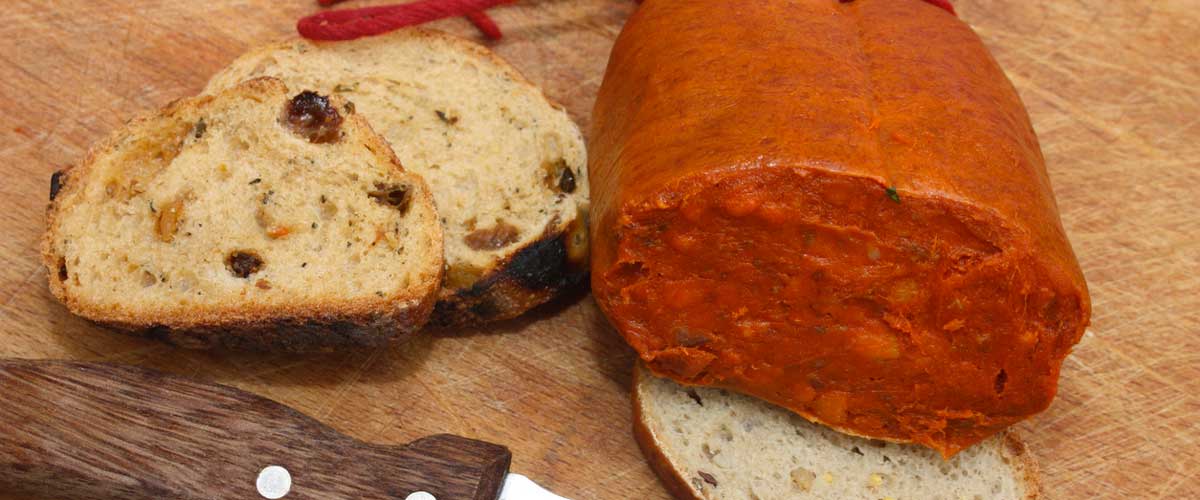
Sobrasada, written soubressade in French, is a spreadable cured sausage from the island of Mallorca, in the Balearics. Its soft, deep-red paste combines pork, paprika, salt and spices. That texture, closer to a spiced pâté than to a dry sausage, is what sets it apart from every other Spanish charcuterie.
If you are simply after the meaning of the word: sobrasada and soubressade are the same product. The first is the original name, the second its French form.
What exactly is sobrasada?
Sobrasada is a raw cured sausage, finely minced and stuffed into a casing, which you do not slice but spread. The traditional recipe holds few ingredients: pork, fat, paprika, salt and a handful of spices. Paprika plays a double role, giving the product its characteristic red colour and helping to preserve it.
Those proportions explain its nutritional profile. Per 100 g, our sobrasada provides 597 kcal, 61 g of fat including 22 g of saturates, 10 g of protein and 2.5 g of salt. It is a rich product, meant to be served in small amounts, which its spreadable form naturally encourages.
Sobrasada de Mallorca carries a Protected Geographical Indication. This European certification guarantees that it was made on Mallorca, following the island's methods. Not every sobrasada on the market holds it: it is the first mark of quality to look for on a label.
Sobrasada, sobrassada, soubressade: how is it spelled?
The spelling varies, and for good reason. The product goes by three names depending on the language:
sobrassada, in Mallorcan Catalan, the original form;
sobrasada, in Castilian Spanish, the one carried by the PGI "Sobrasada de Mallorca";
soubressade, in French, a phonetic transcription settled by usage.
To these three add the variants you come across in writing: sobresada, sobressada, soubresade. They all mean the same thing. In English, "sobrasada" is the form to use.
Where does sobrasada come from?
A charcuterie born of preserving pork
Sobrasada belongs to the family of preserving charcuteries, the ones made to keep the meat of a pig slaughtered all at once. On Mallorca that work had its moment in the year: les matances, the autumn family slaughter, when the whole animal was processed over two or three days. Sobrassada is its emblematic product.
Mince the meat and fat finely, mix them with salt and paprika, then let them mature in a casing: there is no secret to the method. The island's climate, mild and humid, does the rest. It slows the drying and leaves the product its paste-like texture, where a drier climate would have produced a firm sausage.
A name older than the recipe
The name is thought to come from sopressa, "pressed", a term also found in Italian soppressata and recorded in Sicily as early as the 15th century, when the Crown of Aragon linked the two islands. But the red sobrasada we know could not have existed before the 16th century: paprika comes from the Americas, and the recipe only took on its colour and flavour once it reached Europe.
Two accounts still circulate about its origins, one crediting Mallorcan shepherds, the other Moorish influence on the island. Neither is established. What is certain is that Mallorca made it its own, and that the product then travelled: to Catalonia, to Valencia, and well beyond Spain with its emigrants.
Sobrasada and the pieds-noirs
Many French families know this sausage not through Mallorca but through Algeria. The Oran region held a large population of Spanish descent, coming in good part from Alicante, Valencia and the Balearics. It brought its charcuterie along, and soubressade stayed in pied-noir memory as a fixture of the kémia, the spread of small dishes served with drinks.
Memories vary from one family to the next: some describe a spreadable paste, others a firmer, spicier sausage, depending on what the local butcher made. The closest product today is spicy sobrasada, whose chilli gives the bite associated with that taste.
Mild or spicy: which one to choose?
Both versions share the same base of pork and paprika. What separates them is the chilli.
Mild sobrasada does not bite. The paprika brings fruit and colour without heat. It is the one to start with when discovering the product, and the only one that works with children.
Spicy sobrasada adds chilli. It stays a long way from hot peppers and its heat fades quickly, but it holds up better in cooking, where the rest of the dish always softens it.
Both of our references come in 250 g vacuum packs, made with Spanish pork. They contain milk and may contain traces of nuts and sulphites.
How to eat sobrasada
The simplest use remains the best: spread on bread, preferably toasted, at room temperature. On Mallorca it is often served on pa amb oli, a slice of bread rubbed with olive oil and sometimes tomato.
Sobrasada spreads with a spoon and will not hold in slices: that is what sets it apart from other Spanish charcuterie.
The most interesting pairing is the one the island has always practised: sobrasada and honey. The sweetness tames the heat and brings out the paprika. Served that way, on warm bread, it changes register entirely.
In cooking it behaves like a rich, fragrant condiment. A spoonful melts into an omelette, over roast potatoes, into a tomato sauce or onto a pizza base before baking. On the barbecue, spread on bread at the end of cooking, it uses the heat to release its fat and aromas.
How should it be stored?
Vacuum-packed and unopened, sobrasada keeps in a cool place until the date shown on the pack. Once opened, keep it refrigerated and well closed, and eat it within a few days. Take it out a quarter of an hour before serving: cold, the paste stays firm and spreads poorly.
Sobrasada or chorizo: what is the difference?
Both are pork charcuteries with paprika, which explains the confusion. Everything else separates them. Chorizo is dried for longer and is sliced; sobrasada keeps a paste-like texture and is spread. The mince is far finer, the fat content higher, and the result is eaten with a spoon or a knife, never in rounds.
The different formats of sobrasada
On Mallorca, sobrasada does not come in a single shape. The name changes with the casing used, and so with the calibre and the length of maturation: bisbe, cular, bufeta, rizada, poltrú, or the tarrina, sold in a tub. Large pieces mature more slowly and develop deeper aromas; small ones are ready sooner and stay softer.
The island also distinguishes ordinary sobrasada from the one made with porc negre, the Mallorcan black pig, a local breed with fattier, fuller-flavoured meat, which holds a specific mention within the PGI.
Two frequent questions
Is sobrasada eaten raw or cooked? Raw. It is a cured product, ready to eat as it is, like a dry sausage. Cooking is one way to use it, not a required step.
Can it be frozen? Yes, and the texture takes it well since it is already paste-like. Freeze it in its original pack if intact, and thaw it in the fridge so the fat does not separate.
Where to buy sobrasada
It stays rare on supermarket shelves outside Spain, where the range usually stops at chorizo. The safest route is a Spanish charcuterie specialist, checking two things: the origin of the product, and the PGI Mallorca mention on the label.