


Soubressade (sobrasada): the complete guide
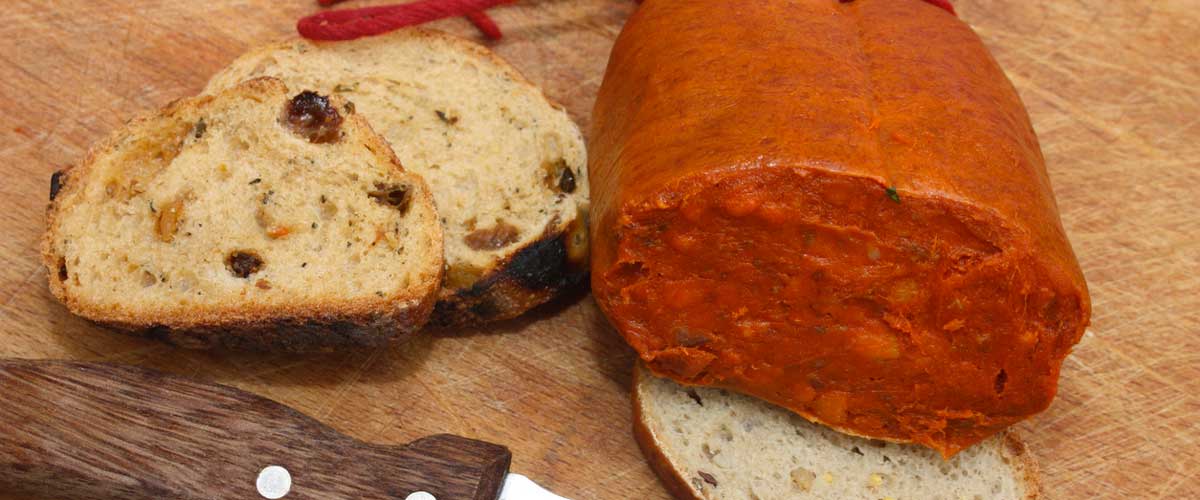
Spanish charcuterie SoubressadeSoubressade, written sobrasada in Spanish, is a spreadable charcuterie originally from the island of Majorca, in the Balearics. Its soft, deep red paste combines pork, paprika, salt and spices. This texture, closer to a spiced rillette than a dry saucisson, is what sets it apart from every other Spanish charcuterie.
If you're simply looking for the translation of the word: sobrasada and soubressade refer to the same product. The first is the original name, the second its Frenchified form.
What is soubressade?
Soubressade is a raw charcuterie, finely minced then stuffed into casing, that is not sliced but spread. The traditional recipe uses very few ingredients: pork meat, fat, paprika, salt and a few spices. Paprika plays a dual role here, giving the product its characteristic red colour and helping preserve it.
These proportions explain its nutritional profile. Per 100 g, our soubressades provide 597 kcal, 61 g of fat including 22 g of saturated fatty acids, 10 g of protein and 2.5 g of salt. It's a rich product, best served in small quantities, which its spreadable form naturally encourages.
Sobrasada de Mallorca holds a Protected Geographical Indication. This European certification guarantees it was made in Majorca, using the island's methods. Not every soubressada on the market has one: it's the first quality marker to look for on a label.
Soubressade, sobrasada, sobressada: how is it spelled?
The spelling varies, and that's normal. The product has three names depending on the language:
- sobrassada, in Majorcan Catalan, the original form;
- sobrasada, in Castilian, the one used in the PGI "Sobrasada de Mallorca";
- soubressade, in French, a phonetic transcription established through usage.
Alongside these three forms are variants commonly found in writing: soubresade, sobresada, sobressada, sobrassade. All refer to the same thing. None is more correct than another in French, where only "soubressade" has really become established.
Where does soubressade come from?
A charcuterie born from preserving pork
Soubressade belongs to the family of preserving charcuterie, the kind prepared to make the meat from a pig slaughtered all at once last longer. In Majorca, this preparation had its moment in the year: les matances, the family autumn slaughter, during which the whole animal was processed over two or three days. Sobrassada is its emblematic product.
Finely mince the meat and fat, mix them with salt and paprika, then leave them to mature in a casing: there's no secret to the process. It's the island's mild, humid climate that does the rest. It slows down drying and leaves the product with its pasty texture, whereas a drier climate would have produced a firm saucisson.
A name older than the recipe
The name is thought to come from sopressa, "pressed", a term also found in Italian soppressata and attested in Sicily as early as the 15th century, at a time when the Crown of Aragon linked the two islands. But the red soubressade we know today could not have existed before the 16th century: paprika comes from the Americas, and its arrival in Europe had to happen before the recipe could take on its current colour and taste.
Two stories still circulate about its origins, one attributing it to Majorcan shepherds, the other to Moorish influence on the island. Neither is established fact. What is certain is that Majorca made it its speciality, and that the product then travelled: to Catalonia, to Valencia, then well beyond Spain with its emigrants.
Soubressade and the Pieds-Noirs
Many French families know soubressade not through Majorca, but through Algeria. Oranie was home to a large population of Spanish origin, coming largely from Alicante, Valencia and the Balearics. They took their charcuterie with them, and soubressade has remained in the memory of the Pieds-Noirs as a staple of the kémia, that assortment of small dishes served with drinks.
Memories vary from family to family: some describe a spreadable paste, others a firmer, spicier sausage, depending on what the local butcher made. The product closest to it today is spicy soubressade, whose chilli gives it the bite associated with that taste.
Mild or spicy: which to choose?
Both versions share the same base of pork and paprika. What sets them apart comes down to the chilli.
Mild soubressade isn't spicy. Paprika brings it fruitiness and colour, without heat. It's the one to start with when discovering the product, and the only one that goes down well with children.
Spicy soubressade adds chilli. It remains a long way from hot chillies and its heat fades quickly, but it holds up better in cooking, where the rest of the dish always mellows the whole.
Our two products are sold in 250 g vacuum packs, made from Spanish pork. They contain milk and may contain traces of nuts and sulphites.
How to enjoy soubressade
The simplest way remains the best: spread on bread, ideally toasted, at room temperature. In Majorca, it is often served on pa amb oli, a slice of bread rubbed with olive oil, sometimes tomato.
The most interesting pairing is one the island has always practised: soubressade and honey. The sweetness tames the heat and brings out the paprika. Served this way, on warm bread, it takes on a completely different character.
In cooking, it behaves like a rich, fragrant condiment. A spoonful melts into an omelette, over baked potatoes, into a tomato sauce or onto pizza dough before baking. On the barbecue, spread onto bread at the end of cooking, it uses the heat to release its fat and aromas.
How to store it?
Vacuum-packed and unopened, soubressade keeps in the fridge until the date shown on the packaging. Once opened, keep it in the fridge, well resealed, and eat it within the following days. Take it out a quarter of an hour before serving: cold, the paste stays firm and spreads poorly.
Soubressade or chorizo: what's the difference?
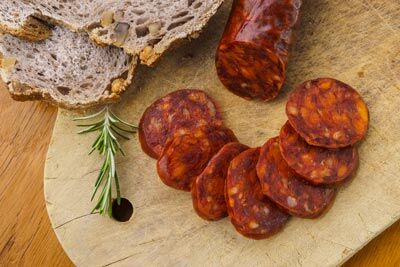
Both are pork charcuterie flavoured with paprika, which explains the confusion. Everything else sets them apart. Chorizo is dried for longer and is sliced; soubressade keeps a paste-like texture and is spread. The mincing is much finer, the proportion of fat higher, and the result is eaten with a spoon or knife, never in rounds.
The different formats of soubressade
In Majorca, soubressade doesn't come in just one form. The name changes with the casing used, and so with the size and maturing time: bisbe, cular, bufeta, rizada, poltrú, or the tarrina, sold in a tub. The larger pieces mature more slowly and develop deeper aromas; the smaller ones are ready sooner and stay softer.
The island also distinguishes standard sobrassada from that made with porc negre, the black Majorcan pig, a local breed with fattier, more flavourful meat, which carries a specific mention within the PGI.
Two common questions
Is soubressade eaten raw or cooked? Raw. It's a matured charcuterie, ready to eat as it is, like a saucisson. Cooking is one way to use it, not a required step.
Can it be frozen? Yes, and the texture handles it well since it's already pasty. Freeze it in its original packaging if it's intact, and let it defrost in the fridge to stop the fat from separating.
Where to buy soubressade?
It remains rare in French supermarkets, where the shelf is usually limited to chorizo. The safest option is to go through a Spanish charcuterie specialist, checking two points: the product's origin, and the PGI Mallorca mention on the label.
You'll find both our versions, mild and spicy, on the buy Sobrasada de Mallorca page, alongside the rest of our Spanish charcuterie.
Learn more
Receive our new products, our tips and our promotions directly in your email box
You may well receive a surprise when you subscribe... 🤞
We will only send you information related to our site, only twice a month, and you can unsubscribe at any time!